
Architects of Learning: How The Village School and Khan Network Are Reimagining Education
While adults in schools around the world are busy crafting rules and policies to control students’ use of AI, The Village School (TVS) is inviting learners to decide when, where, and how to use AI for their own learning. This summer, The Village School joined the Khan Schools Network (KSN) as their first partner on the east coast, with the goal of integrating their mastery-based and learner-centered approach to double down on the human-centered skills that will serve young people best in the technological landscape of the future.
Established in 2023, the Khan Schools Network was founded to unite schools with the shared mission of mastery-based learning and to create open source resources to expand their reach and influence. There are currently a total of five partner schools, including the first Khan Lab School established in 2014 in Mountain View, California. The Village School’s partnership with the Khan Schools Network promotes a timely approach to education: agency over achievement, creativity over compliance, and mastery over memorization. Rather than turning kids into AI guinea pigs, Head of The Village School Maria Vogelei wants to “empower them to become architects of their own learning and creators of technology, not just consumers." True to one of The Village School’s key beliefs, that learning happens best in community, the bi-coastal partnership is designed to draw on the strengths of both organizations and continue to foster innovative, meaningful learning experiences for young people.
Both KSN and TVS place a high value on learner agency through mastery-based learning, project-based curriculum, and experiences. On both campuses, mastery is often achieved through experiential and place-based learning, where young people are invited to be architects of their learning experiences alongside adults fostering creativity, curiosity, and critical thinking. The Village School’s investigation into AI policy is a prime example of the type of agentic experience that leads to mastery of both content and skills. Middle schoolers between the ages of 11 and 13 grappled with the same questions many adults are facing about AI and its role in education:
How can I use AI as a learning partner that strengthens my skills rather than replaces them?
What are the hidden benefits and unexpected risks of AI in my daily life and learning?
What AI guidelines would help our learning community thrive while staying true to our values?
Learners built policy through experimenting with AI, consulting with AI researchers and policy makers, and sharing their findings in a published book for an audience of other young people trying to make sense of the role AI should (or shouldn’t) play in their lives at home and at school. In order to determine where to start with their acceptable use policy, learners consulted AI for several weeks as they completed various tasks both in and outside of school. They reflected on their academic learning and also their mindset: how did they feel after using AI? Trust is at the center of the final recommendations the learners developed; they are fine-tuning a policy based on trusting themselves and each other to determine when consulting AI adds to their learning as opposed to robbing them of the experience.
Positioning young people as capable contributors who are trustworthy enough to experiment with AI and determine their own thoughts, feelings, and opinions regarding its use in schools and the world is a stark contrast to how most schools are managing the emergence of AI by adding rules and restrictions. Risky as it might seem, this type of trust is the foundation from which agentic learning experiences are built and true mastery can be reached.
In order for young people to believe in their own abilities and know they have a voice in their own experiences, they must be trusted to learn from their own experiences. In this case, that means learning from their own experience using AI. Restricting or controlling their use communicates no trust, resulting in the kind of disengagement and disempowerment that has become the status quo in most classrooms and schools resulting in graduates who are disengaged, disempowered and ill-equipped to navigate the world.
Experiences like these, where learners are invited to co-create learning experiences and school policy, are what lead to mastery, not memorization, another key throughline in the KSN partnership. When young people approach learning with the goal of mastery rather than memorization, they develop character and uniquely human skills such as persistence, flexibility, deep understanding, and a moral compass that will serve them well in the future. Learning to master something also means learning about yourself. When learners at The Village School were asked to explain what mastery means to them, here is how they responded:
“Mastery means that I can do it on my own.” –7 year old learner
“When you master something, you feel really proud because you know you’ve worked hard to get there.” –11 year old learner
“Mastering something is different because it means you really understand and can teach it to someone else.” –9 year old learner
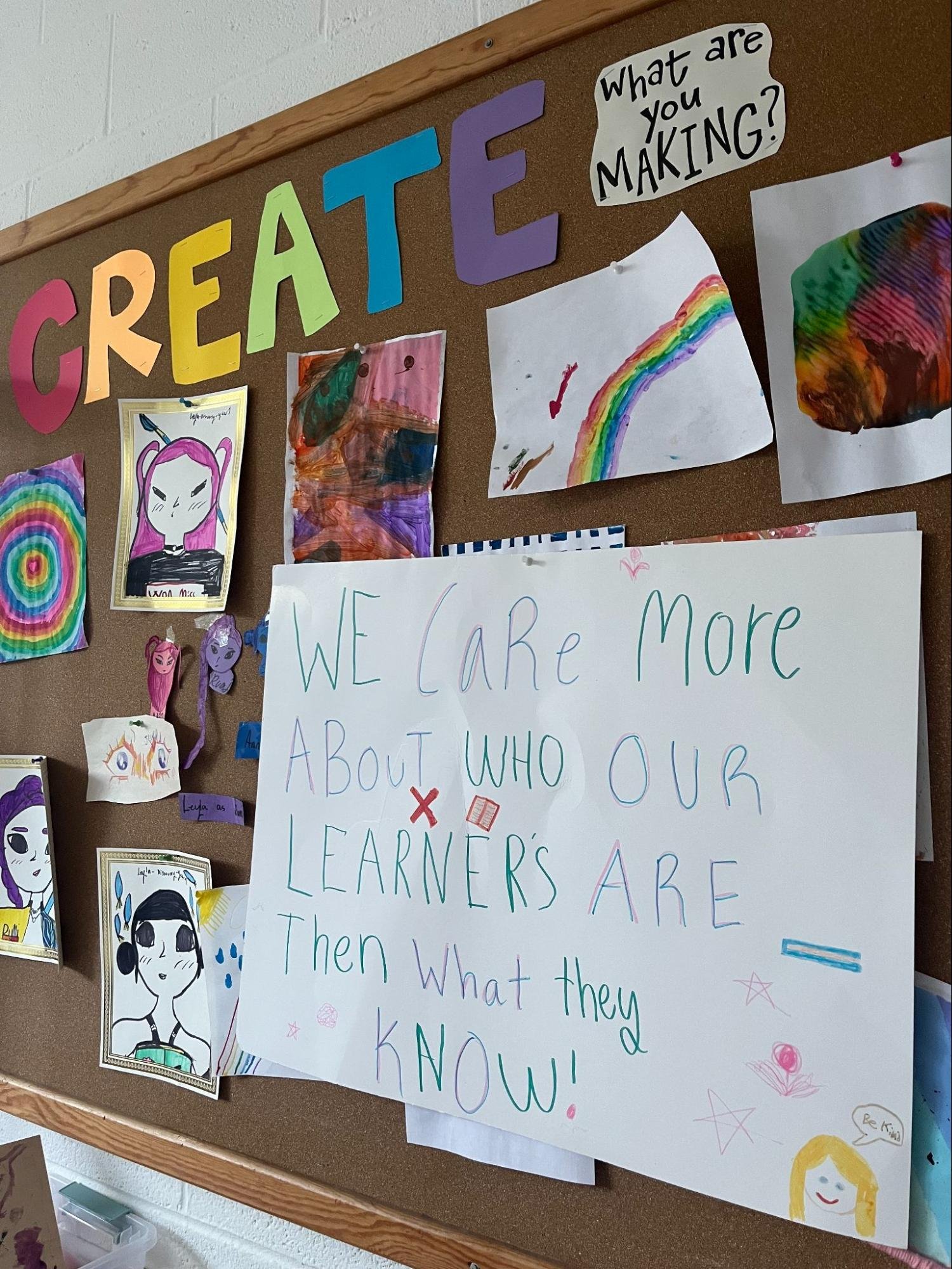
The meaningful personal reflection evident in these learners’ sentiments is part of the human-centered design of mastery-based learning that serves as a blueprint for the Khan Schools Network. Positioning the development of uniquely human traits such as reflection above knowledge acquisition has been a defining tenet of The Village School’s approach as well. The sentence “We care more about who our learners become than what they know” can be found on the website and physical walls of the school. The introduction of AI has confirmed this belief, as demand for what is innately human becomes an advantage. The world has witnessed what happens when powerful technologies like smartphones are introduced without teaching young people how to engage thoughtfully, and school communities cannot afford to repeat those mistakes with AI.
KSN’s focus on mastery provides a foundation for TVS’s future-oriented learning model, which is focused on the types of learning most important in this new age of AI. Despite the unique learning environment of TVS, these approaches are possible in any classroom or school. Educators in any context can be inspired and adapt these strategies to reimagine their classroom, school, or district.
Agentic Learning: The school deeply trusts young people to design, direct, and learn from their own learning experiences. Through hands-on, real-world projects and ample time for play and exploration, learners develop ownership and take responsibility for their education. This self-directed approach cultivates those uniquely human skills—creativity, critical thinking, confidence—resulting in young people who are able to navigate life’s challenges independently. Learners who have developed agency in their learning experiences will be equipped to have agency in the world, which will be paramount in a world reliant on AI capabilities. What will set these learners apart is their belief in themselves as difference-makers who are ready to take action and make a positive difference in the world around them.
Human Connection: The Village School's micro-community environment nurtures meaningful relationships among learners, educators, and community members. As technology like AI pulls society toward more screen time and fewer face-to-face interactions, the school intentionally creates spaces for genuine connection, emotional expression, and community building. This space is important for developing resilience, belonging, and strong character. Human connection is the social-emotional work of the future, where our competitive advantage will be to know ourselves.
Digital Mindfulness: Recognizing that technology is unavoidable, The Village School equips learners with skills to thoughtfully engage with technology as creators, not just consumers. Learners will experiment with how to navigate digital environments ethically, evaluate information critically, and recognize both the potential and limitations of technological tools. Learners will converse with experts and professionals in the real world who are dealing with the rapid advancement of technology in real time. This approach empowers young people to be mindful of their consumption, make intentional choices about how they use technology, distinguish fact from misinformation, and understand the broader implications of digital systems on themselves, their community, and their world. This will prepare them to shape, rather than merely be shaped by, the technological landscape.
One of The Village School’s signature learning experiences that delivers on all three of these pillars and prioritizes an authentic view of mastery learning is the middle school apprenticeship program. At TVS, the apprenticeship is a spin on the more conventional internship occasionally offered to high school students, if at all. In another attempt to ensure young people are architects of their own education, TVS invites learners between the ages of 11-14 to step off campus and into the “real world” to learn about what a path to mastery might look like for experts and professionals in their individual fields of interest.
Experiences like the apprenticeship are even more relevant in a world consumed by AI. A real-world experience offers something that AI cannot: the opportunity for young people to navigate ambiguity, solve novel problems, understand the nuanced concept of excellent work in a professional setting, collaborate with others, and most importantly, discover what truly engages them and build confidence in their own unique abilities. These human-centered skills can only be learned through experiences in the real world, not artificial ones.
Over the past several years, TVS learners have secured apprenticeships at the local farmers market, a costume design firm, a podcast recording company, the National Park Service, a local chocolatier, and even the United States Senate. There are now dozens of brave adults who have achieved mastery in various fields and who have welcomed Village School learners into their professional lives.
These kinds of community connections are what make the Khan Schools Network and The Village School partnership so compelling. What types of AI policies or apprenticeships might emerge from an intentional network of schools working towards a similar goal of trusting young people to reach mastery and beyond?
Through this partnership, both organizations aim to prove that mastery-based learning and learner agency are more essential than ever in preparing young people to thrive in their technological future. The Khan Schools Network and The Village School hope to demonstrate that when young people are trusted as architects of their own learning, they don't just adapt to technological change—they help define it.

Elizabeth Dean, Ed.D is a lifelong learner who is passionate about challenging the status quo in education. She believes young people are capable of much more than the world gives them credit for, and she specializes in creating authentic learning experiences that champion student voice, agency, and belonging. She loves spending time outdoors with her family and her dog, and in the studio on the potter’s wheel.